


Undergraduate Degree Programme:
BSc (Hons) in Informatics and Computer Science
The programme provides students with a strong foundation in computing, information technology and the application of digital technologies to real-world challenges.
It combines theoretical knowledge with practical experience, encouraging students to develop analytical thinking, problem-solving, programming, design and project-development skills. Students build a broad understanding of computing before developing more specialised knowledge through one of five areas of specialisation.
The programme offers five specialisations:
1. Artificial Intelligence
This specialisation focuses on the development of intelligent systems capable of analysing information, learning from data and supporting decision-making. Students explore the principles and applications of artificial intelligence, including machine learning and other techniques used to address complex problems across different domains.
2. Computer Networks and Cyber Security
This specialisation addresses the design, operation and management of computer networks, together with the technologies and practices used to protect digital systems and information. Students develop an understanding of network infrastructure, communication technologies, network security and cyber threats.
3. Computer Science
This specialisation provides a strong foundation in the fundamental principles of computing, programming and software development. It develops students' ability to analyse computational problems, design algorithms and build effective computing solutions.
4. Information Systems
This specialisation explores how information technologies and systems support organisations, business processes and decision-making. Students develop an understanding of information systems, data management, systems analysis and the role of technology in organisational development and digital transformation.
5. Software Engineering
This specialisation focuses on the systematic development of reliable and maintainable software systems. Students gain knowledge of software requirements, design, implementation, testing, quality assurance and project management, preparing them to contribute to professional software-development projects.
Learning Experience
Across the programme, students develop both technical and transferable skills through academic study, practical work, projects and collaborative activities. The learning experience encourages independent thinking, teamwork, communication, creativity and the ability to apply knowledge to practical problems.
The programme prepares graduates for employment in the computing and technology sectors, as well as for postgraduate study and continued professional development.
Degree Award and Recognition
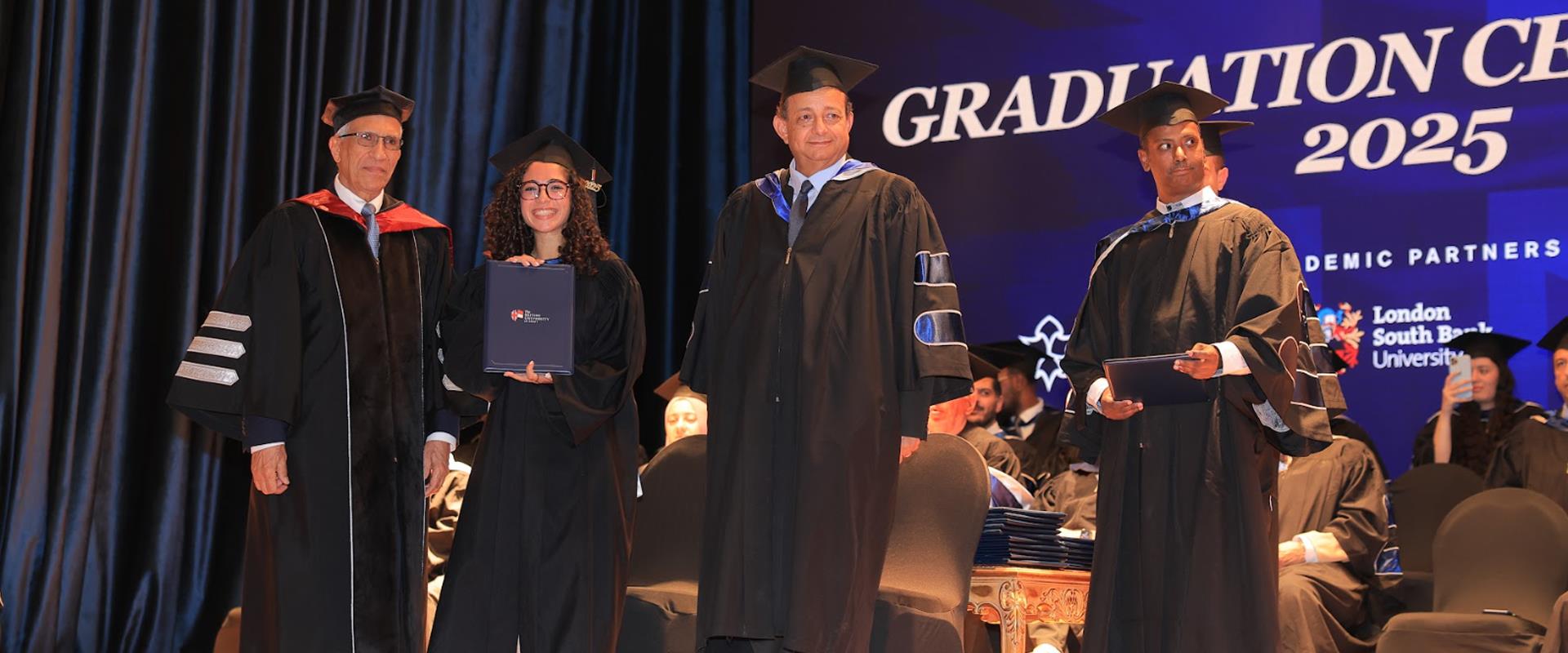
Graduates of the BSc (Hons) in Informatics and Computer Science receive two certificates: one from the British University in Egypt (BUE) and a second from London South Bank University (LSBU). The degree is also recognised by the Supreme Council of Universities (SCU) in Egypt.
.
Postgraduate Programme
MSc in Web Science
The Faculty's postgraduate provision includes the MSc in Web Science, which focuses on advanced concepts, technologies and research in the evolving field of the World Wide Web.
Web Science is an interdisciplinary field that examines the Web from technological, analytical and social perspectives. The programme explores how web technologies, data, networks and online communities are designed, developed, analysed and used.
The programme covers a range of advanced topics, including:
- Web Science and Web Technologies: The principles and development of the Web, web architectures, web services and emerging web technologies.
- Web Topologies and Network Analysis: Graph theory, network structures, graph algorithms and the analysis of complex web and social networks.
- Web Modelling and Big Data Analytics: Data modelling, statistical analysis, predictive techniques and the analysis of large-scale and unstructured data.
- Semantic Web and Knowledge Processing: Knowledge representation, ontologies, linked data and technologies for developing intelligent web applications.
- Web Mining and Information Retrieval: Techniques for extracting knowledge from web content, structure and usage data, alongside information retrieval and search technologies.
- Social Networks: The architectures, technologies and methods used to model, analyse and develop web-based social networking systems.
- Software Engineering for Web Applications: Software engineering principles and techniques for designing and developing web-based applications and services.
Learning and Research
The postgraduate programme emphasises advanced technical knowledge, critical analysis, independent learning and research. Students develop the ability to investigate complex problems, evaluate existing approaches and apply appropriate methods and technologies to web-related challenges.
Through its multidisciplinary focus, the programme provides a foundation for further academic research and professional development in areas related to web technologies, data analytics, information retrieval, network science and software development.
Degree Award and Recognition
Graduates of the MSc in Web Science receive two certificate: one from the British University in Egypt (BUE) and a second from London South Bank University (LSBU). The degree is also recognised by the Supreme Council of Universities (SCU) in Egypt.